Today our teaching staff attended a seminar by Kath Murdoch, whose book “The Power of Inquiry” has been the focus of our school’s professional development this year. We have been reading through the chapters during our staff meetings and endeavouring to incorporate the principles of her inquiry approach into our classroom practice.
No inquiry classroom works unless there is a strong sense of community within a classroom, to demonstrate a way to build this Kath had us write a question on a card and move around the room asking different people the question before swapping cards with them and continuing around the room.
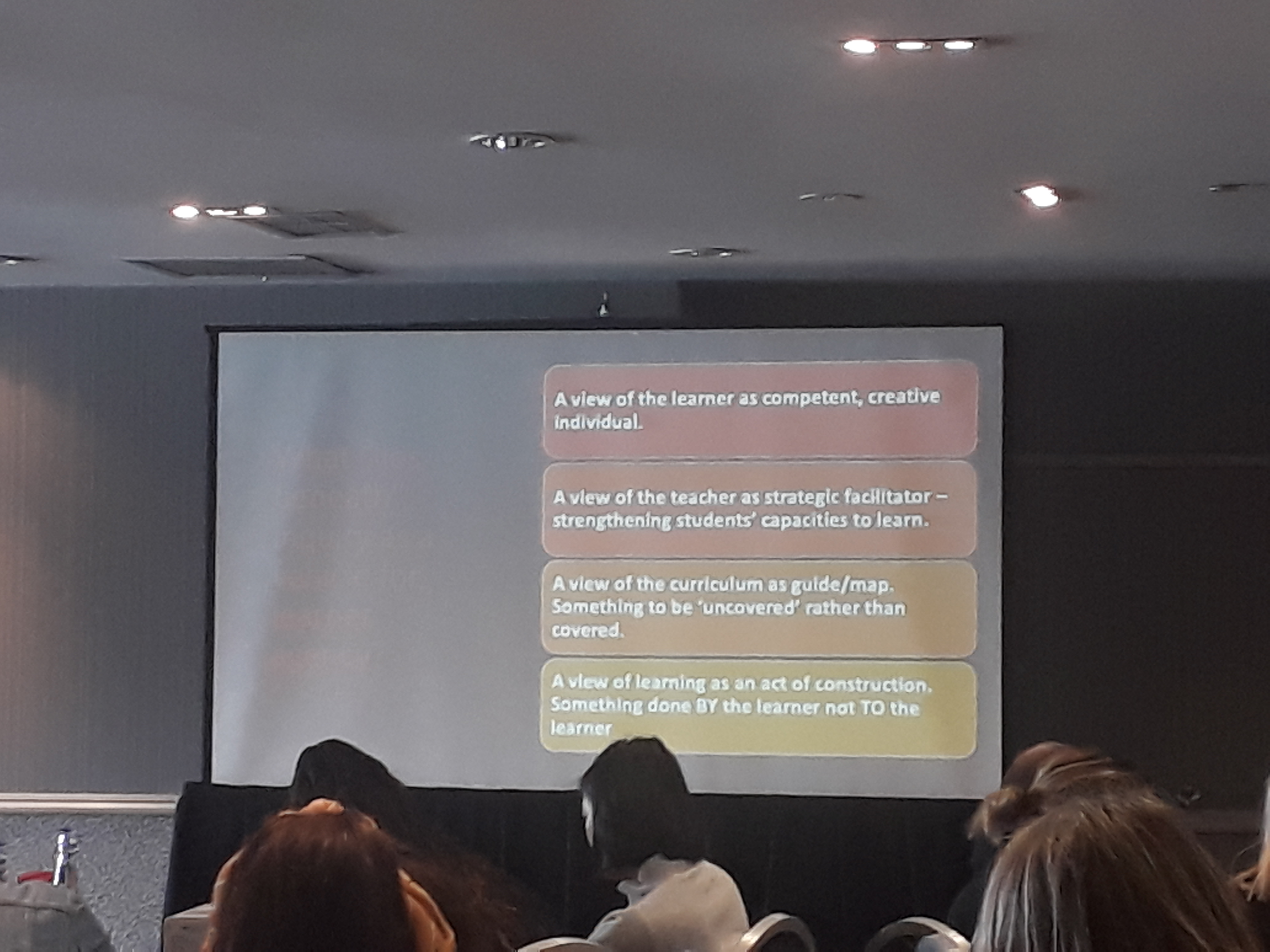
How do we see our role? What is a teacher? How do we see the child as learner? Kath Discusses Julia Aitken’s research around how some teachers struggle to adapt to MLE classrooms and philosophy and others do not struggle. She believes it is down to the vision of the teacher, how they view their role as teacher, how they view the learner, how they view the curriculum and how they view learning itself. (Video of child running, explorefund.org, related to Reggio Emilia, child already capable) We need to view children as able to take risks and view ourselves as able to step back and let them explore.
Kath discussed the way she viewed her role when she first began teaching and compared it to how she views her role now, and mentioned that over time every teacher’s view will change. She asked “what would you call yourself if the word teacher was taken out?” One of the things that get in the way of good inquiry teaching is the teacher’s view of their role (video of teacher unveiling a pile of objects and asking the children to think what it might be).
How do I view the Curriculum? A good inquiry teacher must know the curriculum well so that they do not need to get bogged down in the details, instead being free to adapt learning experiences to fit an inquiry model while still fitting within the framework. Seeing the curriculum as friend not foe, being able to ‘let it go’
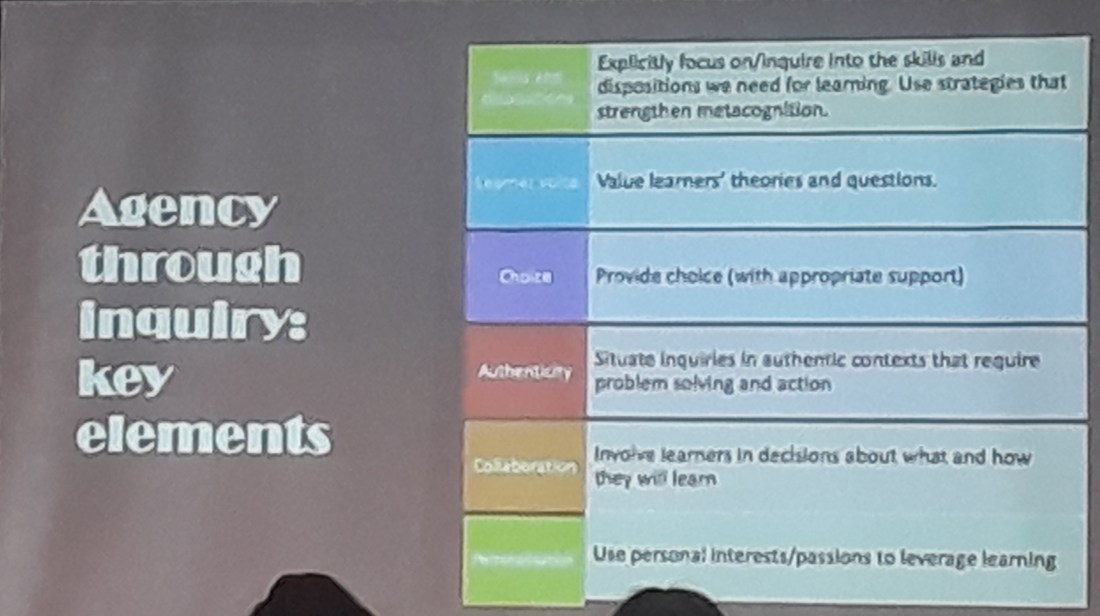
How do I view Learning? What “lies beneath” inquiry as a vehicle for learner agency? (photo of screen) How does learning take place? I feel that learning is often most effective when done through play and games, that learning often needs several approaches before it can be embedded, usually through a range of contexts and tailored to different learning styles.
“How does where you live impact how you live”. This question was used to explore science learning around time zones, seasons, night and day. She used the exmple of her friend texting her in the middle of the night (4am) saying that it was midnight. She asked a group of children how she could figure out where this friend could be.
Then generate quesitons about why there are different times in the world at the same time. Children come up with a theory about why there might be different time zones and see what they can find out through research. Children are aware that they are finding out more, and that it is ok if their theory is not correct. Children share their learning, recognise contradictions in each other’s theories, e.g. one girl thinking that night and day occur when the Earth turned vs a group of boys thinking the Sun and Moon swapped places in the sky.
Children brought something to the table from their own prior experience. In one example, children sorted out the responses of the class to 5 different questions, for instance what are three things we can do to stay healthy? A group of children had the task of organising that data into charts, written statements etc and share back to the class. “We noticed that a lot of people thought this…” Here is an opportunity for children to feed into the inquiry and steer it in a particular direction. This is an example of an activity/learning experience that I would like to try in my class.
Example of the Inquiry Diary: Grade 1 children looked at a rock with a stripe in the middle and wondered how the rock got the stripe. The teacher recorded all the theories of the individual children in a book, the ‘inquiry diary’. Students saw that all their ideas were valid and valued. The teacher write down the thinking “I think that the rock was scratched by a humpback whale…” Then a year 4 class was brought in and their contributions collected “I think that the rock is quartz because I have a collection of rocks at home…”
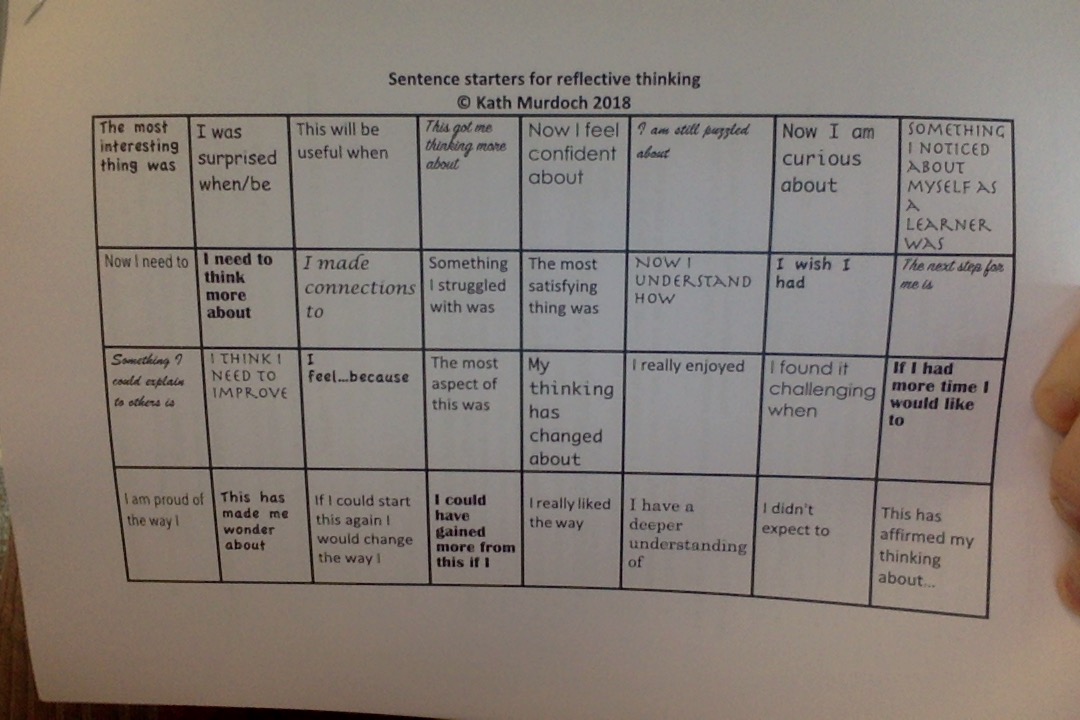
Giving learners responsibility: ONe teacher got children to write their goal for their learning on a whiteboard at the beginning of the lesson. Children wrote things like “I want to stay focussed on my work,” “I will check before I write,” ” I will be a collaborator” etc. During the lesson the teacher presses ‘pause’ on the session to ask the class to check back in with their original goals and comment on their progress.
Kath mentioned a school that had shifted its practice from traditional learning to inquiry based. The student voice showed a difference in how pupils viewed the question of “what makes a good learner?” Children write that they used to think that a good learner had a straight back and always put their hand up, showing that they saw good learners as linked with compliance. My question is: How does this compare to the PB4L model of explicit examples to improve/maintain positive behaviour in a school.
Video of PYP school: Organised classroom so children can find own resources, teacher often poses a question as the learning intention, e,g, ‘we are learning to identify shapes’ becomes ‘how can we identify which shape this is?’ Learning intentions and success criteria is often given as “we are learning to… we are showing our learning by….”
Split Screening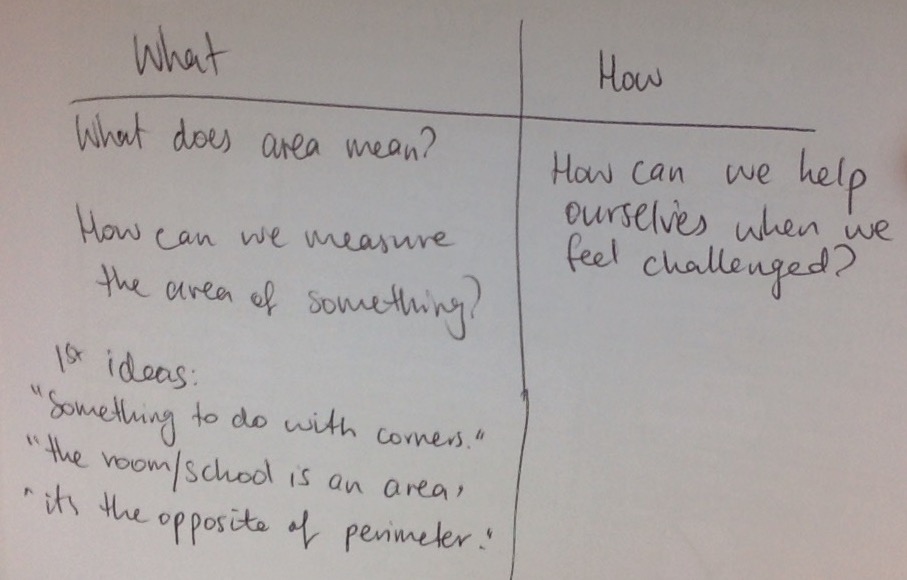
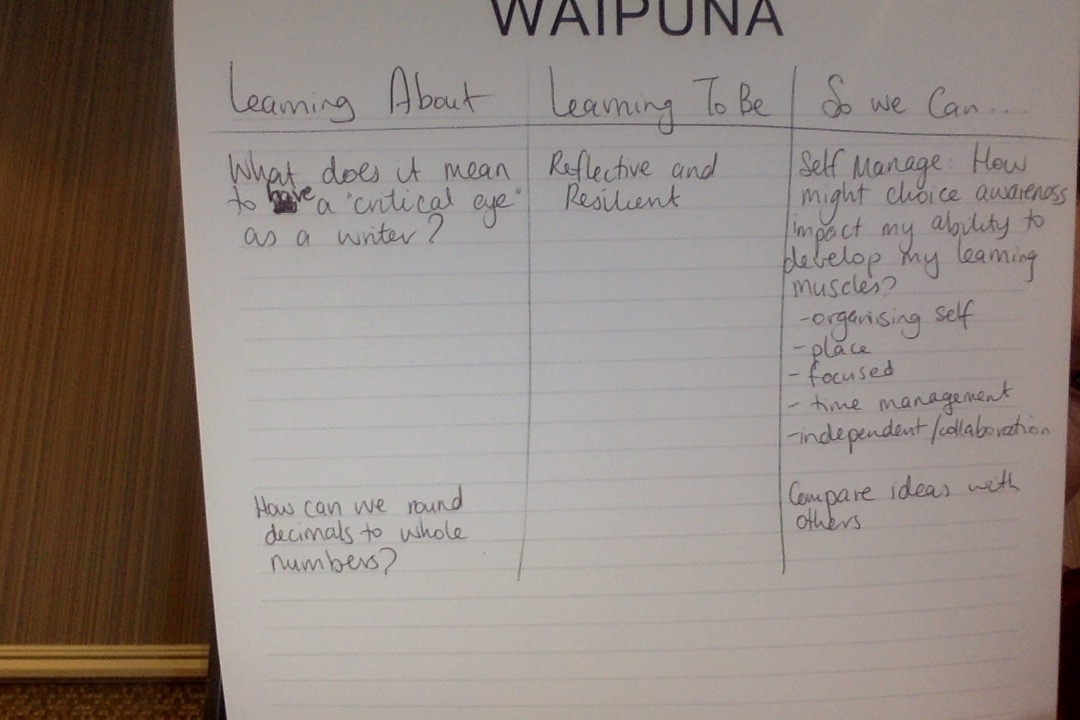
The idea behind this is so that children don’t come out of a maths lesson thinking they have only learnt about maths, there should be a skill they have learnt which can be applied to any context. Consider having an overarching inquiry question such as “what are we learning about ourselves as learners?”
Flipping the Learning
To model a flipped lesson, Kath used the question: What makes a powerful opening to a story? She gave a number of examples and asked us to choose one that stood out as powerful. She recorded our responses as to why we thought the opening was powerful and used that as the criteria, rather than giving us criteria to work from.
She played the video, “Sidewalk Flowers”, a video showing a book without words. We were then tasked with coming up with an opening line for this story.
I do it, We do it, You do it: The traditional lesson sequence. Gradual vs immediate release of responsibility. Sometimes gradual release isn’t enough, sometimes immediate release is required for truly authentic learning to take place.
What is effective feedback? Children need to have examples of effective feedback in order to give it to their peers, but how are those examples presented? Kath gave envelopes of strong and weak feedback to groups and asked students to rate each piece of feedback. Students then went to other groups and compared how they had rated feedback and discussed with each other.
Creating Authentic Moments: Video of Oakley Creek school from Boulder, CA.
Kath also showed us pictures of an example of spontaneous inquiry learning in a class where an arborist was cutting down a tree outside the window. The children wanted to watch and were granted permission to explore the topic, even inviting the arborist to come to speak to their class. Another example was the “Bin Chicken”, the plague of the ibis terrorising children in the playground. The resulting inquiry expanded to include creating ‘owls’ to put up around the school as a deterrent as well as a deeper appreciation of the plight of the species and the consequences of littering and human encroachment on natural habitats.
One class organised their own trip to the zoo, including budgeting, scheduling the day, creating permission slips, arranging transport to the zoo and ensuring school protocol is followed. One thing which I am keen to explore is having my Year 5/6 class organise the school athletics day in week 3 next term.
Having broad enough questions is important to ensure a range of experiences can be incorporated within a particular theme. What does art teach us about history? What makes a great film/story? How do forces affect our daily lives? It would be good if the planning for this included a split screen, e.g. What am I doing as a thinker?
Often classes will do an individual inquiry as well as a shared whole-class inquiry, where students choose a topic linked to their own interests. This can mean a class has a plethora of inquiries happening across a range of contexts, for instance one student could be researching the suffragette movement and another the space programme.
One activity Kath gave us was to walk around the room and read statements relating to agency, then share back at our tables what connections we had made with the readings, what ideas challenged our beliefs and what questions we had for the future.
The last video was one of a toddler walking a labrador, leaving the dog and running through a puddle several times before returning to the dog, taking the leash and walking on. This metaphor shows the learner as the risk taker, able to explore tangents while the teacher waits patiently, supporting the learner in their personal endeavour.
 Learning Through Teaching