In early February this year, our RTLB cluster held an annual hui (meeting) in conjunction with the Learning Support service from the Ministry of Education. One of the guest speakers was former Children’s Commissioner and Judge Andrew Becroft, who began by putting on a variety of T-Shirts with various slogans on them.
stating that as educators, we have a great responsibility and opportunity to change the country.
NZ has one of the most unequal education systems in the western world. HE named several things which have contributed to this situation: Tomorrow’s Schools and the shift from an egalitarian model to a competitive model, Unconscious Bias, Shortcomings in Teacher Education, Lack of understanding around neurodiversity, lack of cultural capability within education services such as the RTLB service, lack of suitable personnel to visit kura kaupapa, lack of pastoral care in schools to forge links between families/communities.
NZ needs to do better to understand the impact of Child Poverty, improve outcomes for Maori and Pasifika students, gain a better understanding of neurodevelopment diversity (not disability), be truly child centered, understand mental health issues and effectively address bullying.
NZ does better for it’s seniors than it does for its youth. In NZ, 3% of the over 65 population are in poverty, compared to 18% of people aged under 18. This is the biggest disparity in the OECD. In comparison, the UK has 6% of seniors living in poverty and 16% of under 18s.
Much of this can be traced to the 1991 budget when benefits were slashed. Superannuation increases were linked to wage growth, however benefits were not. This meant that as wages lifted so did the pension, but benefits did not rise to keep pace with this, leading to a growing disparity of incomes.
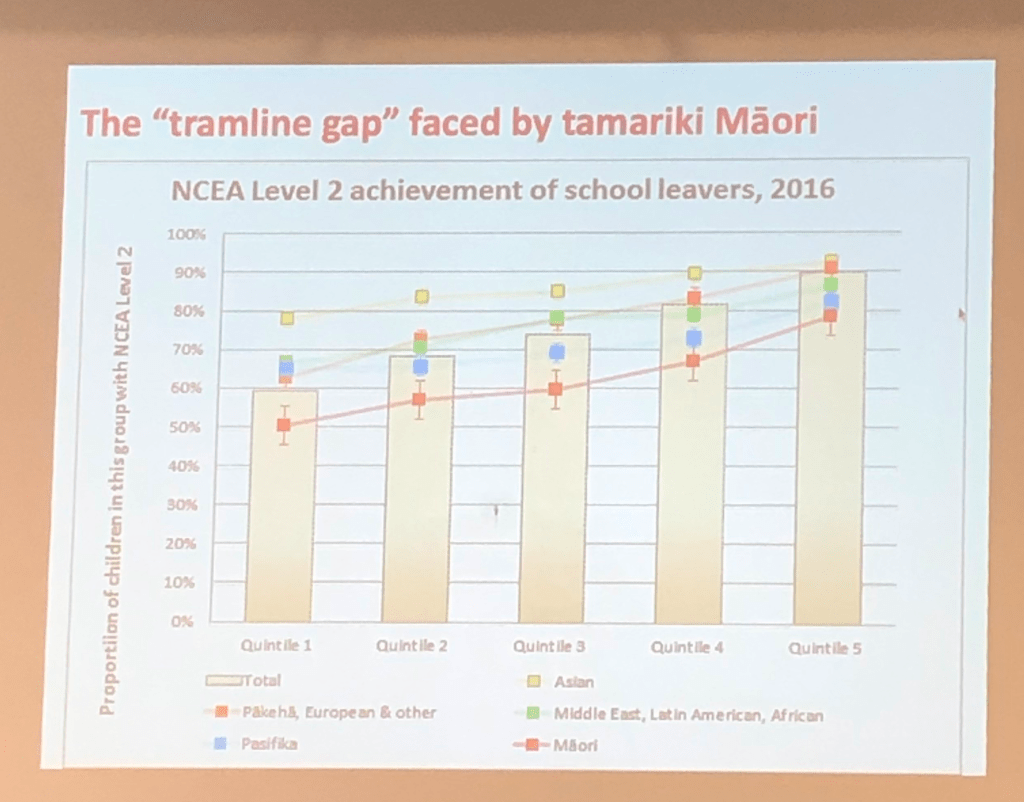
Judge Becroft also spoke about the “Tramline Gap”, the phenomenon shown on graphs plotting the achievement rates of different ethnic groups in schools of varying economic quintiles. It showed that although all children appeared to achieve better at higher quintile schools, the achievement gaps between those children who were Māori and those who were Pākeha remained the same. Although Māori student performance improved, they never caught up completely to students in the other demographics, the width between Māori and Pākeha was the same width at quintile one as at quintile five.
This trend could be linked to the other information Becroft mentioned later on, that in higher decile schools 8.4% of students had Special Assessment Conditions (e.g. Reader-Writers in examinations), however in lower deciles only 2.5% of students were offered these. This was interesting to me because it highlights the inequalities so prevalent in New Zealand schools, and reflects what I have witnessed myself in state primary schools.
Despite not being private institutions and theoretically open to any pupil, the state school system is directed by geography to include or exclude particular groups of students. School zoning has increased the disparity between demographics, as schools in more desirable areas outperform others in traditionally poorer or less desirable neighbourhoods. In the case of particular properties in Auckland, the original desirability of a neighbourhood to middle-class buyers has changed from being linked to proximity to work, transport and amenities, to being primarily driven by which schools they are in zone for. This has led to an increase in house prices and rents in certain areas of the city which are out of proportion to the national average.
A school like Auckland Grammar, for instance, which is nominally a state-run school is a community more akin to a private school, attended almost exclusively by students from wealthy middle-class backgrounds as they are the only demographic able to afford to buy into the area. A quick search on a property website shows huge discrepancies between the valuations of houses which are in-zone for Auckland Grammar compared to those which are not. In some cases, even houses on the same street can vary by close to a million dollars by virtue of being within the desirable catchment or not.
I feel strongly that schools in different areas have hugely varying ideas of what “high expectations” actually means. In one school, high expectations can mean achieving work that is at or slightly below the age-related expectation for that child or children, whereas at another school it would be nothing less than aiming for one or two years above.
This is not always attributable to deficit thinking or unconscious bias on the part of educators. Often, teachers in lower-performing schools are not aware of what their children are truly capable of, having not had the experience in other environments to make that comparison. In my first teaching position at a low-decile school, I was unaware of what the capabilities of a ten-year-old were. It was not until my fourth year of teaching when I moved to a high-decile school that I was presented with student work which was at a very different level to that which I had been accustomed to.
This relates directly to Judge Becroft’s findings on Special Assessment Conditions (SAC), as I believe many teachers do not recognise when a child would seriously benefit from help as they do not recognise them as being as far behind as they are. Looking back on my first class, a child who I believed was ‘average’, sitting comfortably in the middle of my low-decile, high English as Additional Language Learner class, was probably about 2 years below the age-expectation.
Also, I believe there is a lack of awareness about SAC amongst general teachers. While it is discussed within RTLB clusters, and recommendations made where it is deemed appropriate as part of the referral process, many class teachers do not know that it is an option, and do not make these allowances possible for students even when they are identified as needing additional help.
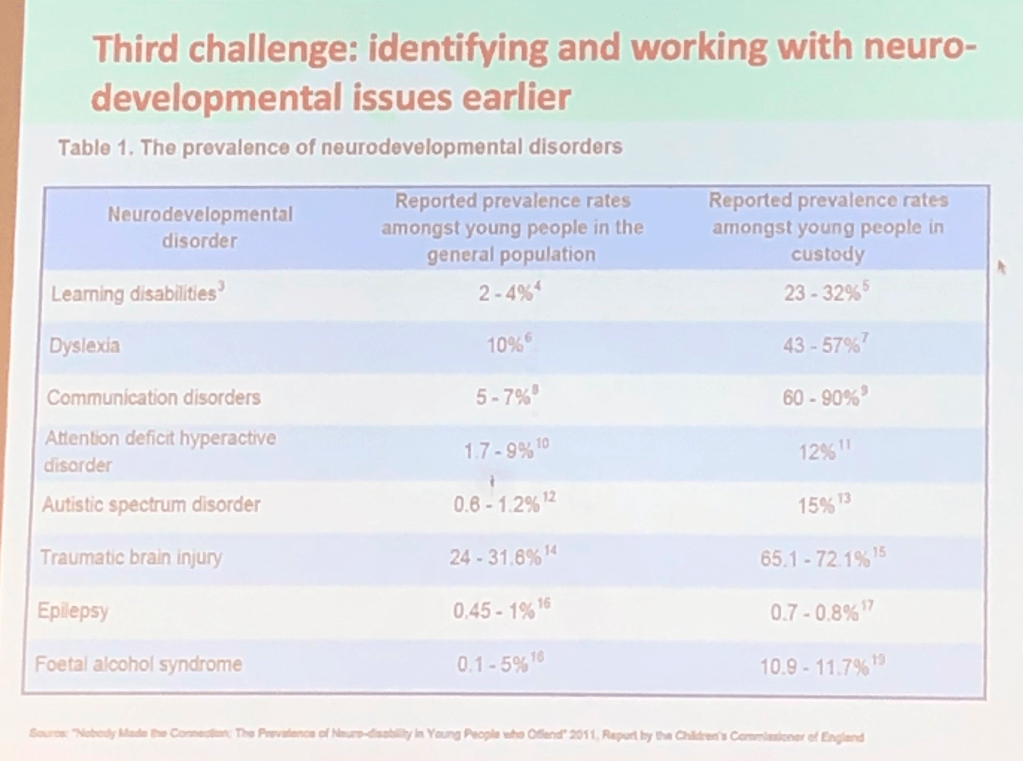
Another interesting point Becroft made was regarding the rates of Neurodevelopment disorders amongst young people in custody compared to that of the general population. As he said, no one had made the connection. Perhaps this was because many people see mental health in a compartmentalised manner, occasionally linked to education but separate from poverty and the justice system, instead of seeing all of these things as intrinsically tied together as part of a more general social malaise.

 Learning Through Teaching