The Coronavirus has exposed many holes in our current society, none more gaping than the access to technology experienced by thousands of New Zealand students who are unable to actively participate in education, either in class or remotely, due to a lack of electronic devices or internet connection. The New Zealand Government announced arrangements for 17,000 Chromebooks or iPads to be shipped to homes across the country to attempt to address this glaring disparity, however it remains a point of contention that adequate resources were not available within the education system prior to this global emergency.
Recent television news reports attempting to show the brighter side of The New Normal have often focused on higher decile schools and their response to the crisis: small bubbles of happy children in classrooms adequately supplied with digital technologies and the vast majority of their community ensconced at home, learning remotely with their teacher just one mouse-click away. Sadly, this is not the reality for many New Zealand learners.
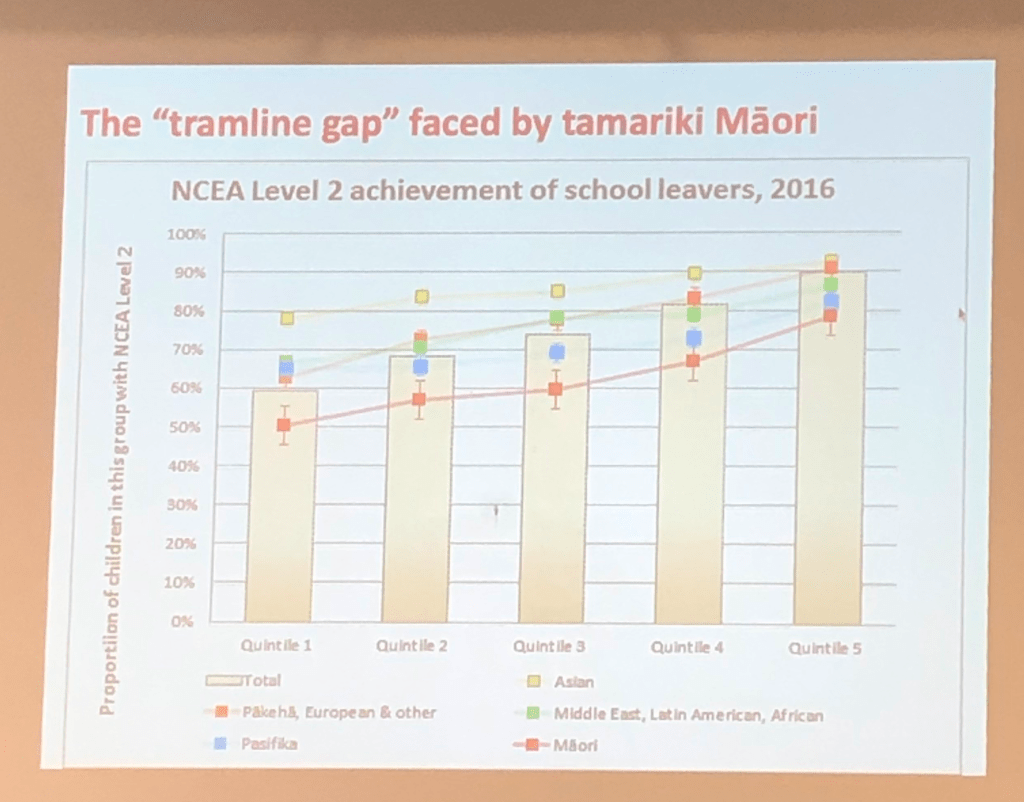
Education in New Zealand is currently at its most unequal. Some children are thriving in this new online era, uploading pictures and videos of themselves completing a learning task, communicating daily with friends and teachers while being tutored by supportive family members. Others may have to share technology with siblings and compete for bandwidth with harried parents working from home. There are those without devices who are completing hard copy home learning packs supplied by the government, and there are yet others for whom home is not even a safe place, let alone one where learning can take place.
Teaching colleagues have spoken during the lockdown of how difficult it is to make contact with students and their families outside the physical bounds of the school, as bubbles migrate and regroup under the different levels and lack of access to technology limits communication between home and school. Administrators and teaching staff try to make contact with a family using a mobile number that has now been disconnected, or visit a home only to discover that no one now resides at that address. The most difficult times for a society are felt even more acutely by its most vulnerable.
Inequality within the education sector has long been acknowledged, but it seems to have been treated as just another sad fact of life. In my first teaching position at a decile one school in Mt Roskill, the staff decided to hold a school disco to fundraise for sports trips. After the teachers sourced the sound equipment, set up the speakers and spent two afternoons decorating the dilapidated school hall we raised just over $300 from the entry fees and the sales of donated food. My next position was at a decile eight school where the disco, quiz nights and other fundraising initiatives run by the highly supportive PTA raised over $2000 each. The contrasts between those schools were stark: a new swimming pool and a dedicated computer suite in the higher decile school; an absence of swimming lessons, and 28 dated laptops on trolleys to service the entire school in Mt Roskill.
Disparities in education due to disparities in welfare cannot be completely redressed by investment in schools alone, but this must be part of the solution. Currently we seem to be operating two curriculums within the same country, one digital, connected and future-focussed, and one paper-based, reactive and isolated. Centralised funding of digital devices would alleviate pressure on schools struggling to find capital for technology while also providing staffing and curriculum resources, perhaps a nationwide scheme for schools similar to the current laptop provision for teachers could be enacted to ensure a 1:1 ratio of devices to children in classrooms.
As the world develops a new modus operandi in the the wake of Covid-19 and more and more companies embrace the option of remote working, questions may be raised about how education will be altered in the coming years. Virtual-classroom learning has become a booming industry in China, where one tutor connects remotely with classes of fee-paying students at mutually agreed times. In this situation, the teacher becomes a contractor, choosing their own working hours in a gig-economy manner similar to an Uber driver. Perhaps in the future, remote learning could be adopted as a kind of outsourcing, a way to semi-privatise education as the running costs are passed onto the domestic household.
One thing that has become clear is how vital it is to have a physical space to act as a focal point for communities. In the good times, a school is a place where friendships are made, both between students and between their families. There are connections born out of rites of passage: the first day of school, sports teams, school plays, sitting exams. In times of hardship, schools can often be the only avenue of support, connecting people with services they could otherwise not have accessed.
Hopefully this crisis will enable a realisation amongst those with political power which will be remembered long after the lockdown ends. Finance Minister Grant Robertson’s pre-Budget speech today called on people to “acknowledge that things weren’t perfect before Covid-19”, and that we should not squander the opportunity to use the economic re-set of the Coronavirus to address these long-term issues. There is so much potential for positive social change at this moment, the zeitgeist tangible in the teddy bears in windows, fuelled by the message “Be Kind”. Let’s hope it lasts.
 Learning Through Teaching